


When most people picture ancient pyramids, they imagine Egypt, yet farther south along the Nile, the kings and queens of Kush built their own striking monuments. At Meroë in present-day Sudan, groups of steep-sided pyramids rise from the desert, marking royal burials and a history of power, craftsmanship, and exchange. These monuments were created within a civilization that knew its neighbors and developed its own traditions, including artistic choices that distinguish Kushite sites from Egyptian ones. Their limited place in many popular accounts of antiquity reveals how easily the public story of Africa can become narrowed to a few familiar locations. The pyramids of Sudan deserve attention because they open up a much richer history of the Nile, one in which African kingdoms made decisions, traded, fought, worshipped, and built monuments on their own terms.
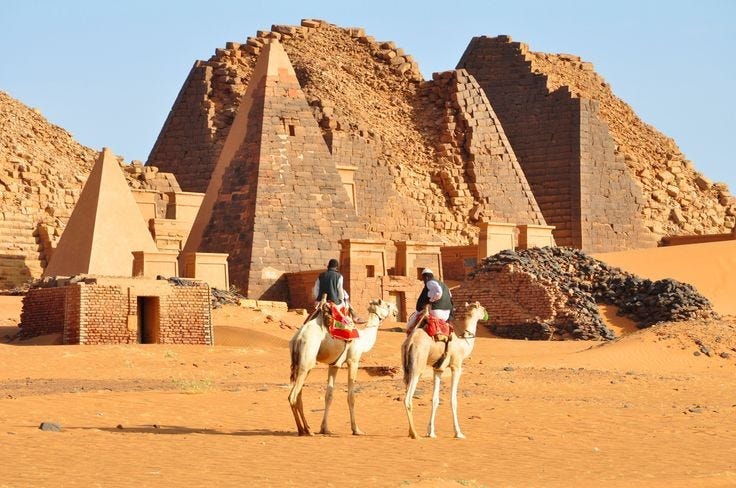
UNESCO locates the Archaeological Sites of the Island of Meroe between the Nile and Atbara rivers and describes the wider Kushite state as a significant power from the eighth century BCE to the fourth century CE. Its leaders at one stage ruled Egypt, while Meroe later became an important royal center and burial site. This chronology matters because it resists the idea that Kush existed only through imitation. The region participated in a long exchange of religious practices, political ideas and technical knowledge, but its institutions developed across changing historical circumstances.
The architectural record demonstrates the connections Kushite rulers maintained with the broader Nile Valley while also revealing distinctive choices about scale, form and royal commemoration. Many Meroitic pyramids are steeper and narrower than the most familiar Egyptian examples, and their associated chapels present reliefs through which rulers and elite families expressed status and religious identity. UNESCO’s documentation also identifies palaces, temples, industrial areas and water-management systems at Meroe, Naqa and Musawwarat es-Sufra. Taken together, these surviving structures indicate the considerable resources, specialized skills and social obligations required to sustain royal burial practices. A pyramid may dominate an image, but the civilization that built it also needed workshops, economic networks, agrithe work artists make and skilled labor.
Kushite architecture should also be read alongside the cultural practices and economic resources that supported the state, including settlement patterns, craft production and movement along the Nile. Royal pyramids give the most dramatic visual evidence, but they are only one part of the archaeological setting and cannot stand in for every aspect of Kushite society. This distinction is especially important when public interest in spectacular monuments encourages simplified comparisons with Egypt, because a culture’s historical importance cannot be measured by the resemblance of its most recognizable structures to those of its neighbors.

Archaeological chronology complicates any attempt to understand the Kushite kingdoms through the political borders that define contemporary northeastern Africa. UNESCO describes the Kingdom of Kush as a major power from the eighth century BCE to the fourth century CE and identifies Meroë as a principal royal residence, with royal burials concentrated there from the third century BCE onward. Its protected setting includes Naqa and Musawwarat es-Sufra, where temples, water installations and other structures expand the record beyond the pyramids themselves. The pyramids cannot be explained adequately through their resemblance to Egyptian forms. Their meaning emerges from specific Kushite choices about power, burial, trade and the management of a difficult environment. This fuller setting prevents the monuments from becoming decorative footnotes to another civilization’s story.
The royal sites preserve evidence of a broader cultural conversation across Africa and the Mediterranean world. Artistic features drawn from Egyptian, local Kushite and other traditions coexist, without requiring historians to treat one society as the origin of every meaningful idea. Cultural borrowing is a normal feature of powerful states, and it can indicate selection, negotiation and political invention. Asking whether a form is wholly indigenous produces a poorer account than investigating how rulers used it to construct authority in a particular place and period.
There are limits to the available record, especially when modern audiences expect ancient societies to provide clear explanations of every monument. Archaeology, inscriptions, objects and surveys of surviving sites make it possible to reconstruct aspects of Kushite life, but the evidence is uneven. An accurate account must acknowledge gaps in the archaeological evidence while resisting the impulse to transform them into exaggerated mystery. The desire for a spectacular secret can obscure the intellectually compelling work of understanding irrigation, trade, craft production and the changing location of political power.

The vulnerability of Sudan’s archaeological heritage has become especially urgent amid the contemporary emergency affecting the country and its cultural institutions. UNESCO’s 2026 World Heritage Committee decision expressed deep concern about the armed conflict affecting Sudan, alongside climate, flooding, conservation and resource pressures at the Meroe property. The resulting danger concerns the physical survival of sites as well as the capacity of researchers and communities to document and interpret them. Damage to sites can destroy evidence, disrupt conservation teams and limit opportunities for Sudanese researchers and communities to protect and interpret their heritage. A monument’s global fame offers little defense if international concern does not translate into meaningful support for the institutions responsible for its care.
The story is therefore about the politics of attention as well as the architecture of antiquity. Ancient Egypt occupies a privileged place in popular education, museums and tourism; the Kushite kingdom receives considerably less public recognition. A fuller account of Kushite achievements can situate Egypt within a shared Nile Valley history without diminishing the significance of either civilization. It calls for telling the Nile Valley’s history as a connected region in which multiple African societies exercised power, shaped artistic languages and left archaeological records that deserve sustained study.

Meroë’s monuments reveal how Kushite rulers developed architectural expressions of power within a connected Nile world, drawing upon exchange while making distinctive choices of their own. Reading those choices carefully restores the full historical complexity of the region and resists the tendency to place Sudan at the edge of an ancient world it helped shape. The pyramids deserve sustained attention as evidence of political institutions, religious practices and artistic judgment, with the lives surrounding them treated as essential to their meaning.